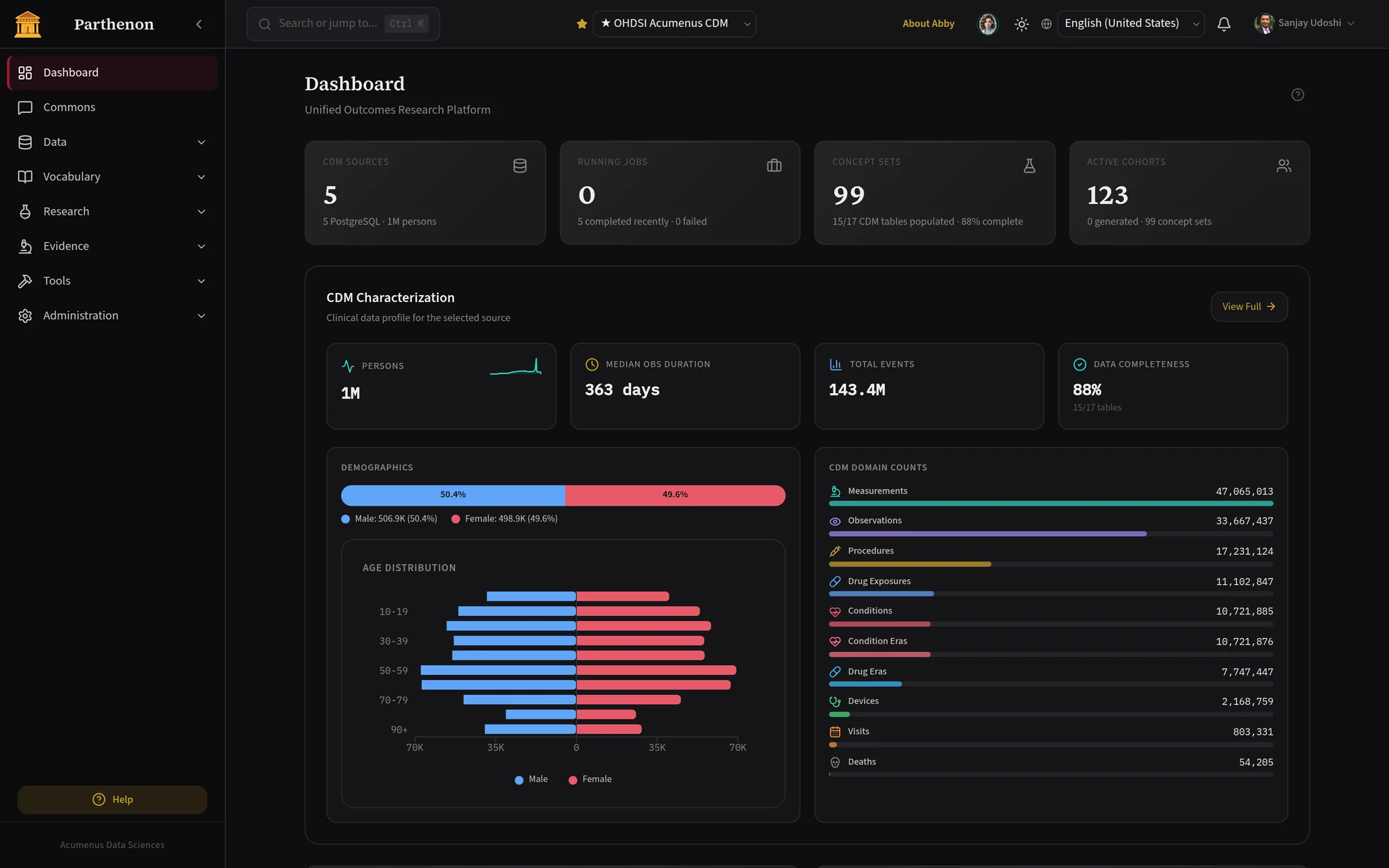
Parthenon set out to answer a question that has frustrated outcomes researchers for a decade: why does answering one clinical question require ten separate tools? Today, that question has a single answer. Parthenon consolidates the entire OHDSI toolchain — Atlas, WebAPI, Achilles, DataQualityDashboard, Usagi, WhiteRabbit, CohortMethod, PatientLevelPrediction, and more — into one application on Laravel 11, React 19, and OMOP CDM v5.4. One login. One Docker stack. One cohort builder that flows directly into characterization, incidence, prediction, and estimation.
Where it stands
The current release, v1.0.8, has been exercised on 1M+ patient datasets. The vocabulary explorer searches more than seven million OMOP concepts; the cohort builder preserves the Circe expression format, so existing Atlas definitions import and run unchanged. Characterization and data quality — roughly 200 Achilles analyses and several thousand DQD checks — run natively, with no R installation required of the analyst.
What shipped recently
The last few months pushed Parthenon well past classic OHDSI. Semantic vocabulary search now runs on a BGE embedding model against a dedicated concept-embedding store, so researchers can find concepts by meaning, not just by string. A FHIR R4 ingestion pipeline landed with live, proven Epic SMART-on-FHIR authentication — real EHR data can flow toward the CDM through a human-reviewed mapping queue that stands in for WhiteRabbit and Usagi. And Abby, the platform copilot, evolved from a question-answering assistant into an action-taking agent: describe a cohort in plain English and Abby generates the structured OMOP expression, explains any cohort, or interprets a result.
Under the hood
A single Docker Compose stack orchestrates the React front end, a typed Laravel API, a PostgreSQL database holding the OMOP clinical and vocabulary tables, and managed R/HADES sidecars for the heavy statistical work. A Python service backs Abby, defaulting to a local MedGemma model so that nothing is required to leave your infrastructure. Heavy analyses run asynchronously through a job queue, so the interface never blocks and throughput scales with your database hardware.
What's next
Near-term work focuses on broadening population-level estimation, hardening the protocol-to-publication study pipeline, and continuing to ground the AI copilot in verifiable, reproducible analytic steps. The discipline underneath it all descends from the conformed dimensional model and evidence-based measures documented in the Geisinger CDS Compendium — the goal remains to make that rigor reproducible, open-source, and runnable by any health system or research center.
 Sanjay M. Udoshi MD
|
Sanjay M. Udoshi MD
|