Product Tour
Inside Medgnosis
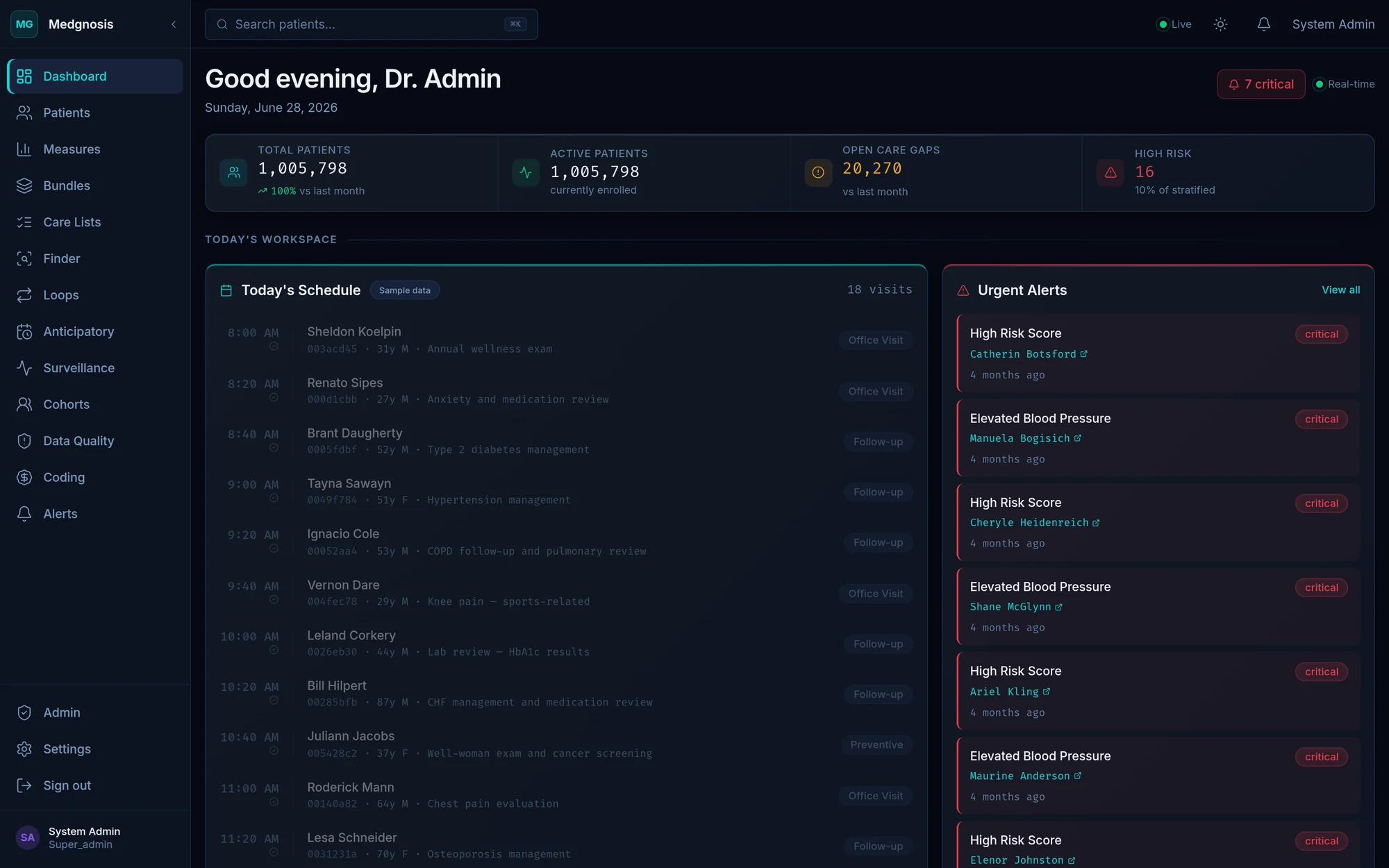
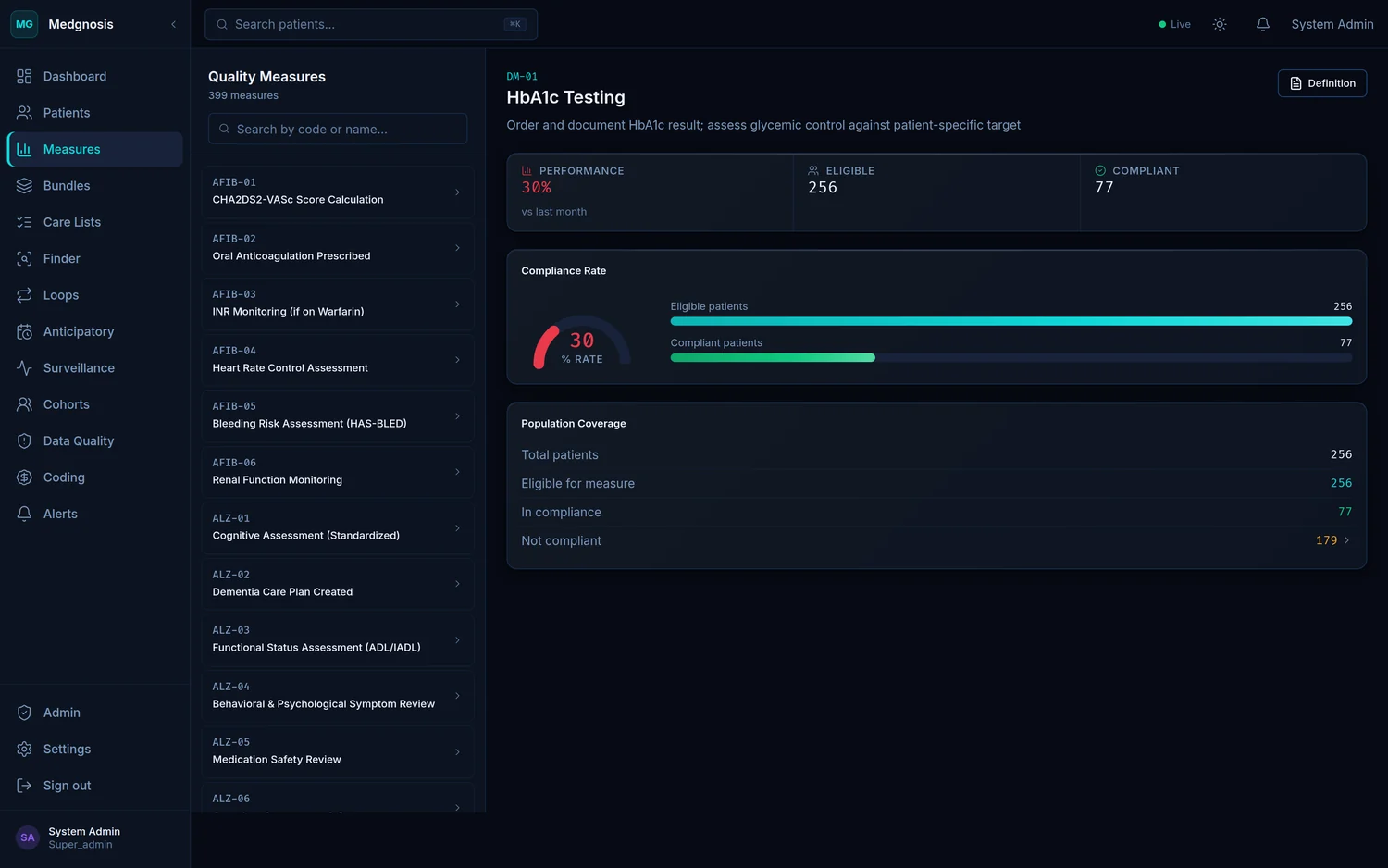
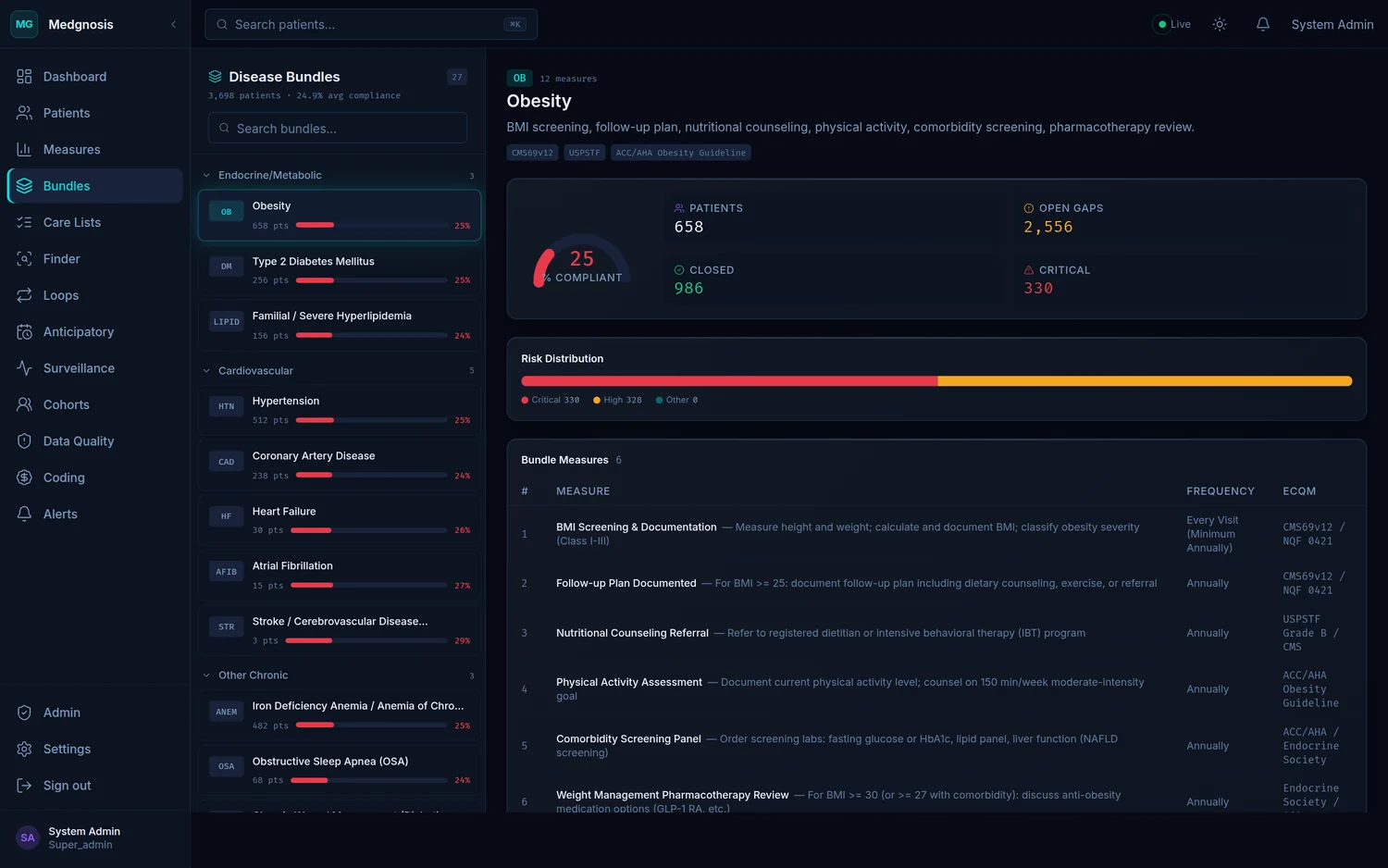
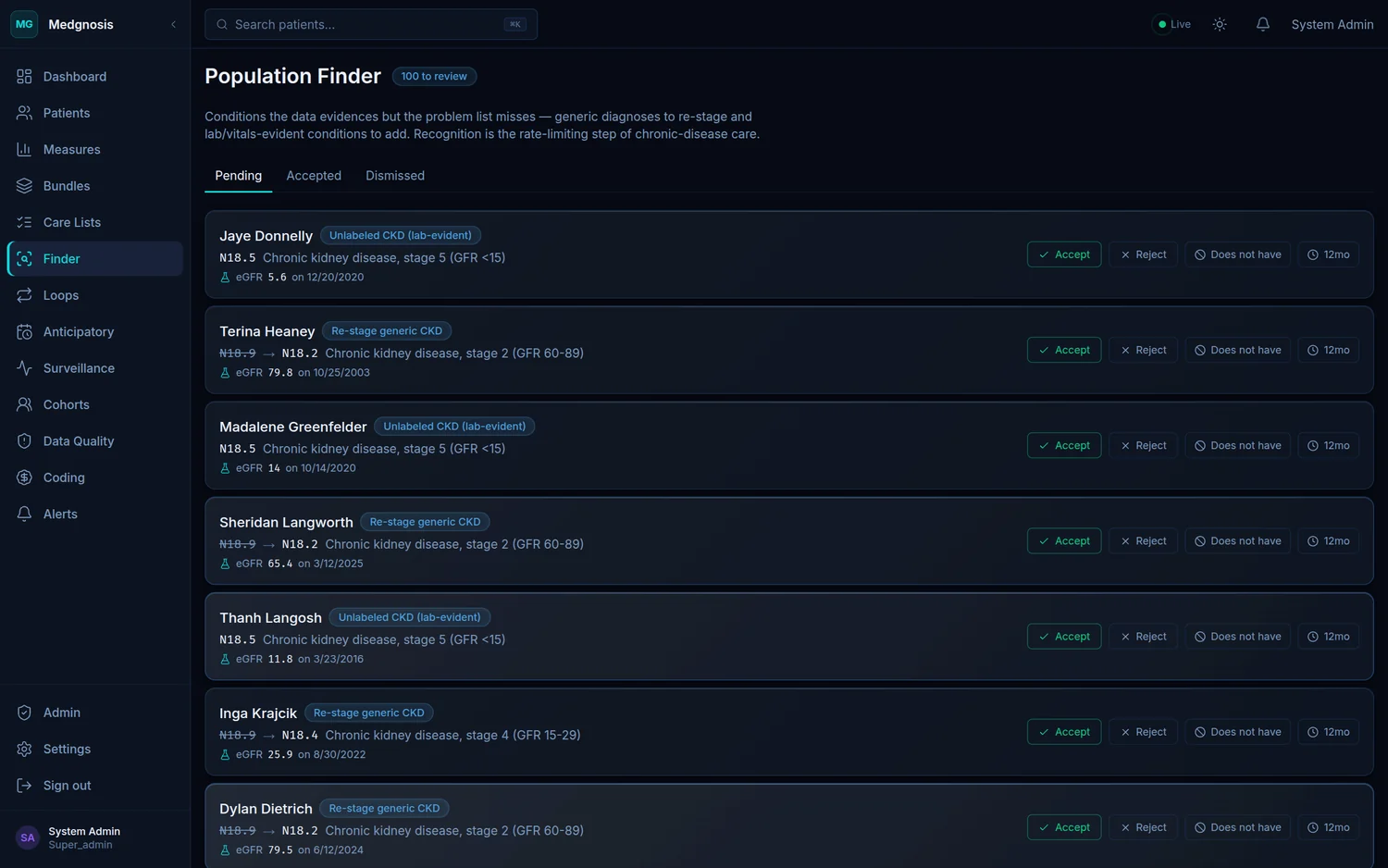
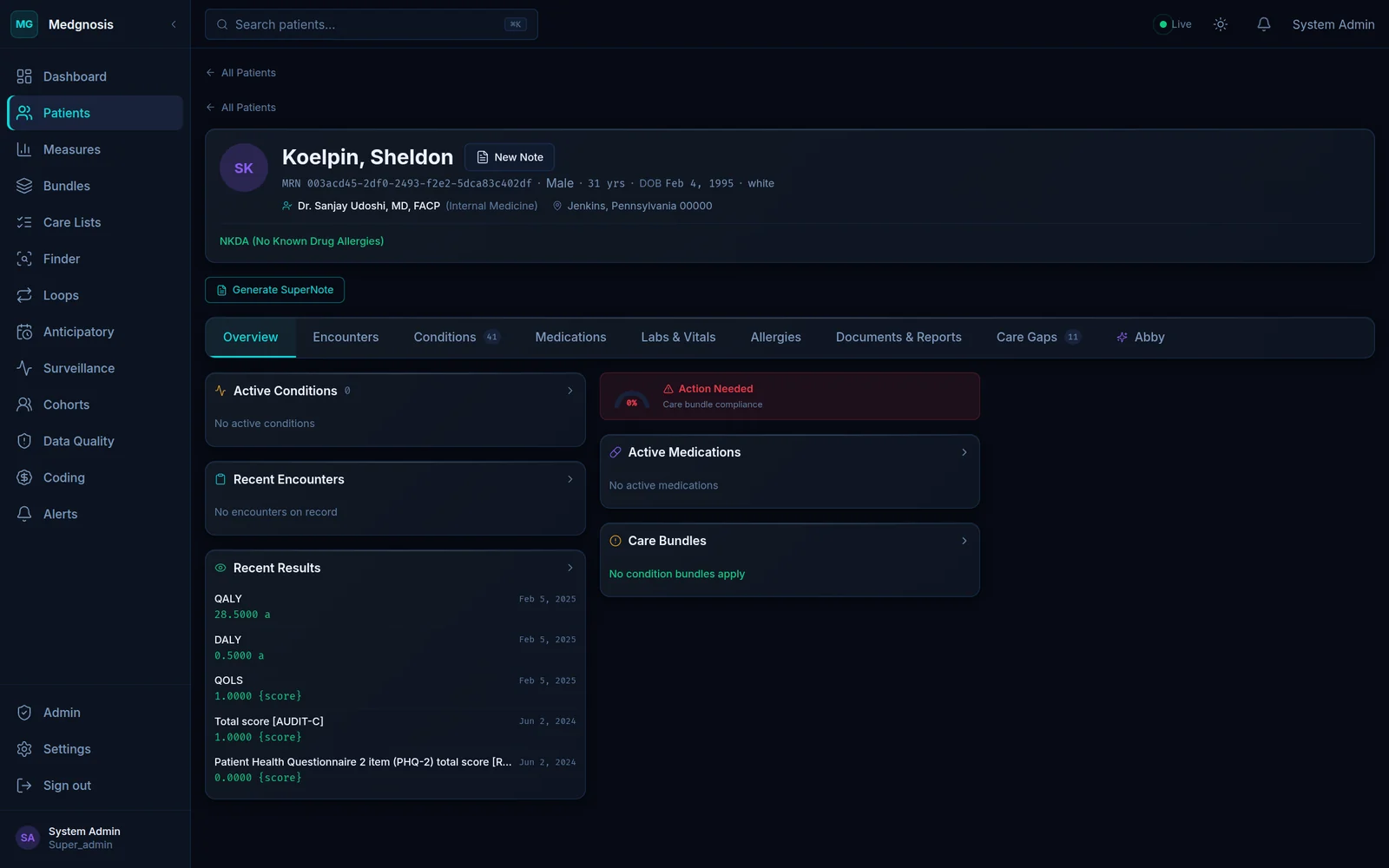
Captured from the live demo on a fully synthetic 1M-patient warehouse — click any view to enlarge.
Standards-native population health and clinical decision support.
Medgnosis pairs a 1M+ patient hybrid warehouse (3NF EDW + Kimball star) with a real-time care-gap engine, a live CDS Hooks 2.0 decision-support surface, FHIR R4 endpoints, and VSAC value-set integration. The design goal is singular: author clinical logic once, against open standards, and serve it across quality measurement, prospective care gaps, and workflow-embedded decision support — with a transparency dossier on every measure.
The Problem
Value-based care organizations face a painful triad. Opaque measurement: vendors publish pass/fail rates, but the clinical logic behind their eCQMs is proprietary and unauditable — quality teams can't verify accuracy or explain a gap to their board. Siloed decision support: care-gap detection, risk stratification, and advisories live in separate products with no shared logic. Lock-in and cost: each vendor's proprietary measure library means parallel ETLs, per-measure fees, and the hope that next year's update doesn't break your submission.
Medgnosis breaks the pattern by making clinical logic — not data — the product: authored against open standards, routed transparently to any program, and published so anyone who must trust it can read it.
Capabilities
Patient-level gaps across 45 evidence-based condition bundles (354 measures), each scored by compliance, due date, and clinical priority. Smart deduplication keeps a patient with both diabetes and hypertension from receiving the BP-control measure twice; gaps push to dashboards over WebSocket.
A 750+ definition catalog spanning CMS eCQMs, HEDIS/ECDS, and APM-model measures. Measures execute nightly against the warehouse with performance rates, age/sex/race strata, and Wilson 95% confidence intervals.
A 7-factor evidence-based risk score bands patients Low–Critical, alongside published clinical scores (CHA₂DS₂-VASc, NEWS2, MEWS, Gail). Every score is transparent and reproducible — governed, not black-box.
Two live discovery services — care-gaps (order-sign) and problem-list (patient-view) — return well-formed CDS Cards directly into the EHR workflow, JWT-authenticated.
Read endpoints for Patient, Condition (SNOMED), Observation (LOINC), MedicationRequest (RxNorm), and a $everything patient bundle — so EHRs, HIEs, and research platforms can query Medgnosis as a clinical data source.
1,545 CMS-curated value sets and 225k+ codes, with per-reporting-period version pinning and drift detection — resolving EDW concepts to VSAC OIDs across SNOMED, ICD-10, RxNorm, LOINC, CPT, and HCPCS.
A 3NF enterprise data warehouse (1M+ patients, 195M procedures, 42M diagnoses, 28.7M encounters) paired with a Kimball star schema tuned for fast measure aggregation.
Each measure carries an API-queryable dossier — value-set version pins, computed results, and (on the roadmap) CQL + ELM + test-deck coverage. Radical transparency no closed vendor will publish.
Optional LLM insights and an AI scribe (BAA-gated Claude or local Ollama) generate care-gap narratives and SOAP drafts — consent-gated, cost-tracked, and PHI-scrubbed from logs.
Standards
We're transparent about what's live today and what's on the roadmap toward fully executable, shareable clinical logic.
Today, measures execute as governed SQL against the star schema. CQL execution ships behind a pre-built seam — we won't claim it before it's proven on test-deck-validated measures.
Product Tour
Captured from the live demo on a fully synthetic 1M-patient warehouse — click any view to enlarge.
Architecture
A typed TypeScript API: auth, patients, measures, care-gaps, FHIR, CDS Hooks, and admin routes with Helmet and rate limiting.
A Vite-built clinician dashboard — schedule, alerts, population risk, and care-gap trends — with TanStack Query and Zustand.
Background workers run the rules engine, nightly measure calculator, AI insights, and ETL — backed by Redis.
phm_edw (3NF clinical), phm_star (Kimball analytics), an app schema for auth/audit, and VSAC terminology tables.
Redis pub/sub fans real-time alerts out to connected clinicians over WebSocket with auto-reconnect.
FHIR mappers project the EDW to R4 resources; a clean evaluator seam is ready to host an external CQL clinical-reasoning runtime.
Who It's For
Stand up one instance, ingest claims/EHR data via FHIR, and execute the Universal Foundation measure set nightly. Clinicians see a unified dashboard of schedule, alerts, and risk tiers — and the organization owns the logic instead of waiting on a vendor update.
Run Adult and Child Core Set measures and real-time care-gap detection across hundreds of thousands of members, with measure dossiers that prove every numerator and denominator decision at audit time.
Ingest clinical data via FHIR, execute eCQMs nightly, and surface gaps to quality teams — with CDS Hooks alerting clinicians during the encounter to close a gap before discharge.
Use Medgnosis as the analytic layer: the engine flags patients overdue for screening or monitoring, and governed AI summarizes the top drivers for a cohort for board reporting.
Why It's Different
Closed EHRs ship eCQM logic as black-box SQL. Medgnosis publishes the measure dossier — auditable, comparable, and challengeable.
Bare CQL runtimes have no analytics or UX. Medgnosis adds a 1M-patient warehouse, dashboards, real-time alerts, CDS Hooks, and terminology — the standards benefits plus the application.
Architected to route one logic artifact across CMS programs, HEDIS, and APM models — "author once, report to many" as a design goal, not a bolt-on.
Every score and model is published or gated behind validation. No marketed-vs-actual AUROC surprises — governed AI by construction.
Medgnosis productizes the care-gap discipline documented in the Geisinger CDS Compendium — the AMP and Auto-Orders programs and the Close-the-Loop engine that closed more than 250,000 evidence-based gaps in care. The same idea, rebuilt on open standards: detect the gap, prove the logic, and act before the visit.
Read the CompendiumUnder the Hood
FAQ
Explore the live demo, or talk to us about standards-native population health for your organization.