Product Tour
Inside the tumor board
From the live demo on synthetic, de-identified cases — click any capture to enlarge.
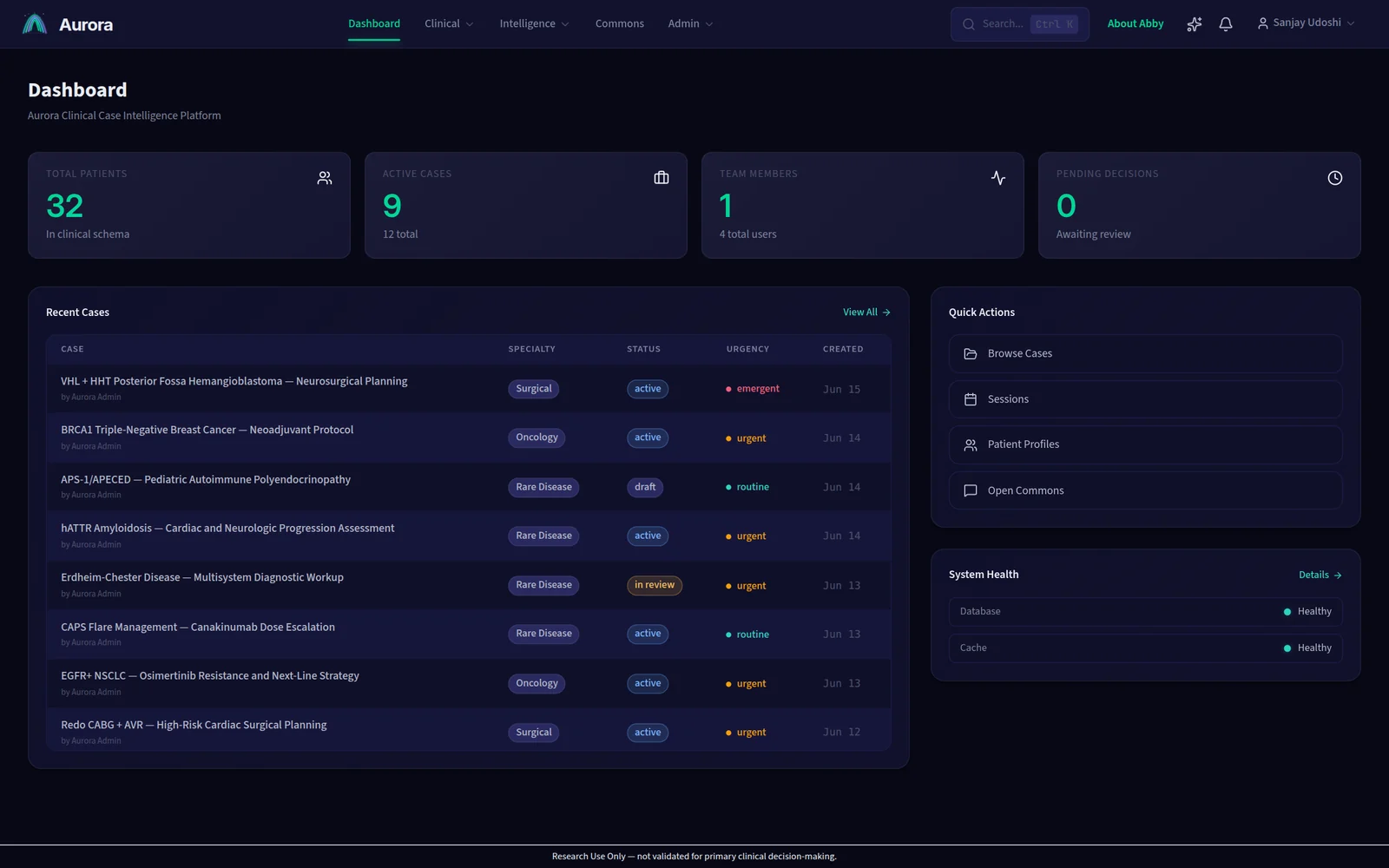
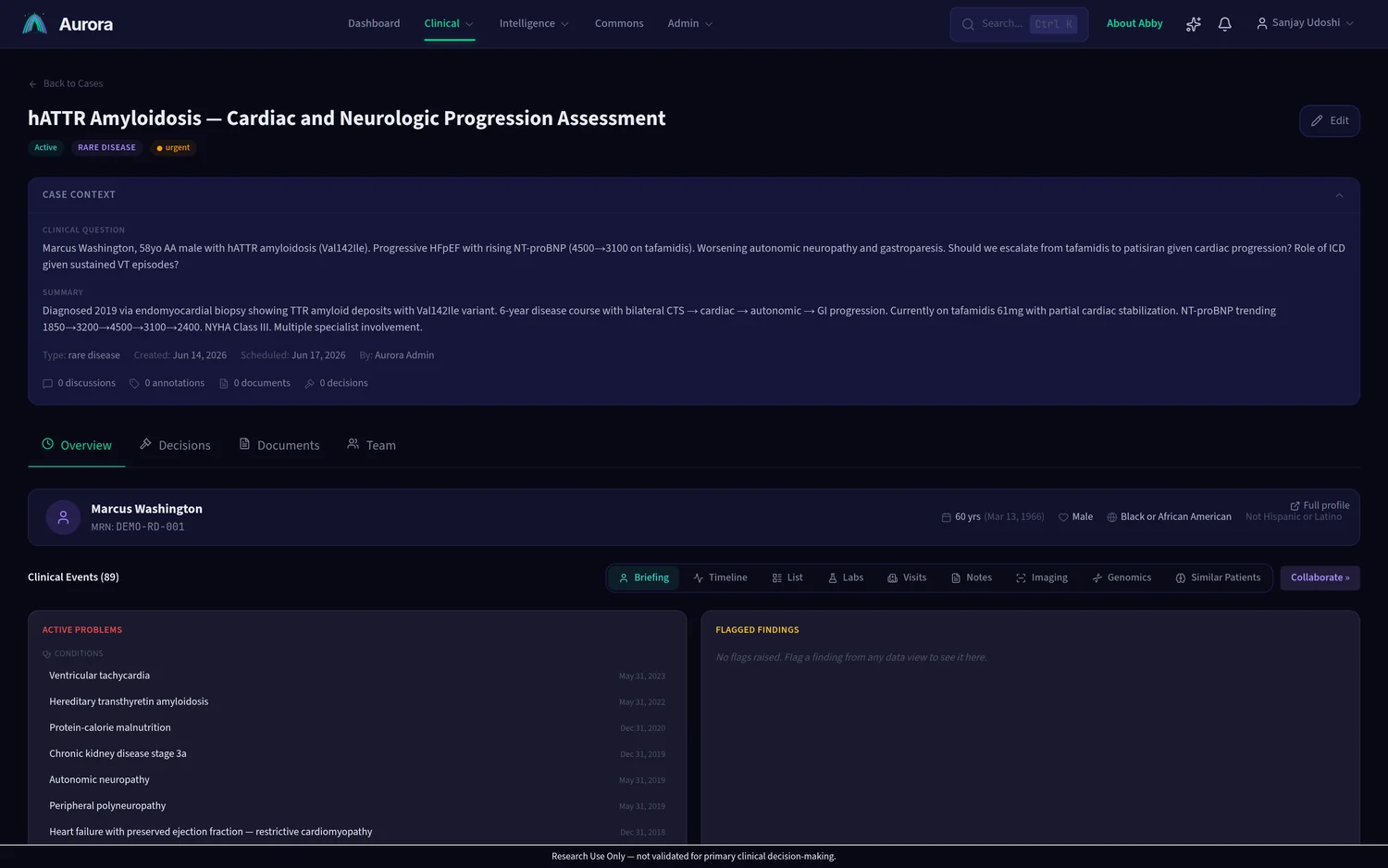
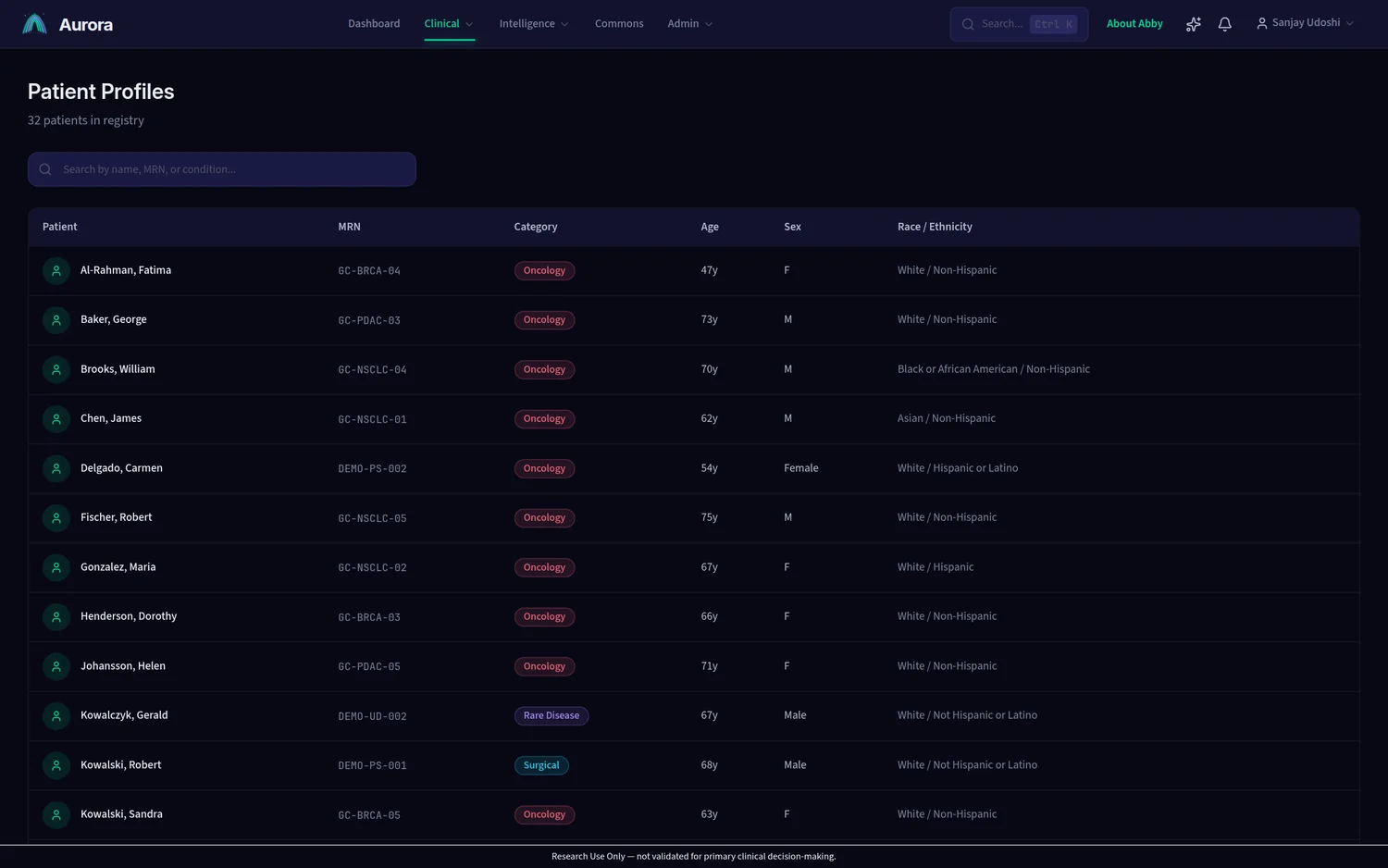
Collective intelligence for complex cancer cases — from genomics to outcomes.
Aurora is an open-source molecular tumor board and precision-oncology collaboration platform. Multidisciplinary teams run live tumor-board sessions, interpret genomic variants, review longitudinal imaging, and capture structured treatment decisions with full audit trails — supported by an AI copilot and optional federated, privacy-preserving “Patients Like This” queries across institutions. Vendor-agnostic and aligned to OMOP, FHIR R4, and GA4GH standards.
The Problem
A molecular tumor board compiles its presentation from the EHR, a genomic report, an imaging viewer, and a trial database — manual work that can cost hours per case. Radiologists and pathologists sit in separate silos. Genetic counselors read variants outside the clinical timeline. And the decision — the actual reasoning of the room — vanishes into meeting minutes, unretrievable for the next case or for research.
When a patient's molecular profile matches someone in another center's cohort, that knowledge is lost. Aurora brings the team into one structured workspace where genomics, imaging, trials, and the decision itself live together — and can be learned from.
Capabilities
Schedule and run live molecular tumor boards with structured case queues, presenter assignment, participant presence, and synchronized views — with session notes generated from the discussion and decision record.
Variants are classified by ClinVar significance and OncoKB actionability, with tier-1 variants surfaced for action. Every variant links to the patient's treatment history and trial eligibility — precision medicine at the point of decision.
Aurora matches a patient's genomic profile to guideline-concordant treatments, flags off-label or guideline-discordant plans, and records the concordance rationale in the decision.
An embedded OHIF / Cornerstone3D viewer supports 2D/3D DICOM, segmentation, and RECIST 1.1 measurement — correlating imaging response with genomic findings into a radiogenomic fingerprint.
Track treatment response over time (CR/PR/SD/PD) against imaging, genomics, and labs — closing the loop between what guidelines predicted and what actually happened.
Every recommendation is recorded with evidence and proposer; the team votes (agree / disagree / abstain), dissent is preserved, and finalized decisions become an auditable, queryable record linked to follow-up tasks.
Normalize data from OMOP CDM or FHIR R4 into one coherent timeline — conditions, meds, labs, notes, imaging, variants, and computed eras — with source provenance and de-duplication.
A streaming clinical copilot interprets variants, matches trials, checks drug interactions, scores prognostic risk, and drafts session notes — on self-hosted Ollama / MedGemma or Claude, with PHI sanitized before any cloud call.
SapBERT embeddings power local pgvector similarity search — and an opt-in, mTLS-authenticated relay lets teams query partner institutions for de-identified similar cases with k-anonymity enforced.
Product Tour
From the live demo on synthetic, de-identified cases — click any capture to enlarge.
Architecture
A typed PHP 8.4 API with Sanctum auth and Spatie RBAC, and adapters that normalize FHIR, OMOP, or manual entry into one clinical model.
Cases, sessions, decisions, genomics, imaging, the Abby chat, and the Commons workspace — TypeScript-strict, with Zustand and TanStack Query.
A FastAPI service computes SapBERT embeddings, genomic briefings, similarity, trial matching, and drug-interaction checks — routing to Ollama or Claude.
Multi-schema (app, clinical, vocab) with pgvector for 768-dimensional patient embeddings and cosine-similarity search.
Laravel Reverb syncs live session state — case view, voting, and presence — across participants in real time.
An opt-in peer relay exchanges only de-identified summaries over mutual TLS, with a peer allowlist and k-anonymity gating.
Who It's For
Display variant-by-variant actionability, surface approved and investigational treatments and trial matches, check interactions, and capture the board's vote and rationale — linked to outcome tracking on the next response scan.
Pathologist, radiologist, oncologist, and genetic counselor work the same case: histology annotations, RECIST measurements, variant interpretation, and a structured decision with preserved dissent.
Aggregate each case's imaging, pathology, genomics, and recent notes before the meeting, run the session live, and hand the registrar a queryable decision dataset for quality and research.
Query partner centers for de-identified cases matching a rare co-mutation, and decide on a regimen informed by real precedent — without any PHI crossing the wire.
Standards
Why It's Different
Aurora is a decision-support and collaboration layer, not an EHR. It is also not a video-conferencing or whiteboard tool — collaboration happens through synchronized case views, threaded discussion, annotations anchored to clinical data, and structured decisions. Run your video platform alongside it and link the case. Aurora's value is the genomics, the imaging, the trials, and the decision record — together, and auditable.
Under the Hood
FAQ
Explore the live demo, or talk to us about precision-oncology collaboration for your cancer center.